
Browse Exhibits (33 total)
Building the Book from the Ancient World to the Present Day: Five Decades of Rare Book School & the Book Arts Press

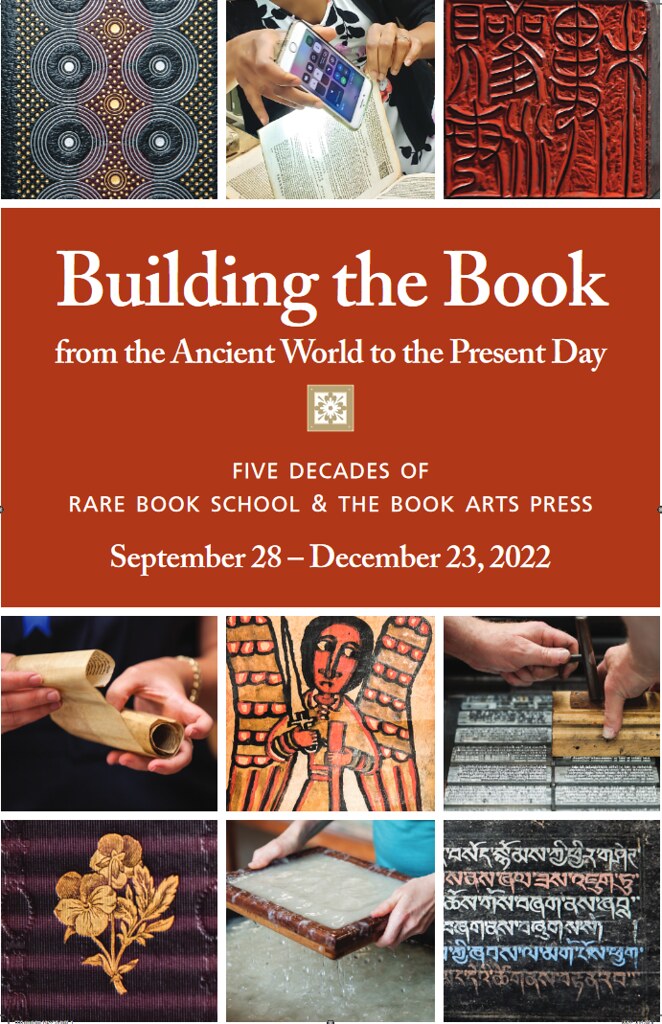
Building the Book from the Ancient World to the Present Day
Five Decades of Rare Book School & The Book Arts Press
We have all been taught how to read books. But what can we learn by looking closely at their material forms? This exhibition celebrates the fiftieth anniversary of Rare Book School and the Book Arts Press, which teaches leading curators, librarians, conservators, book historians, and collectors how to analyze books as physical objects, along with the materials and equipment used to make them.
Crossing borders and time periods, this show attempts to tell the larger story of the book as it reflects human society and culture over more than two millennia. The shapes of books are as varied as those who create them. We use the term “book” loosely, then, to refer to artifacts that fall within a variety of traditions, as well as to gesture toward more unusual objects that invite themselves to be considered as books—sometimes in deliberately self-conscious and provocative ways.
You will find in these cases artifacts from Rare Book School’s teaching collections, ranging from plant fibers and animal skins to glass negatives and photopolymer plates—from woodblocks and metal printing type to floppy disks and digital devices. The items that we have selected are not always beautiful, and many of them are not particularly “rare.” What is special about this collection is its purpose: to advance our understanding of the physical book and to preserve its history. Digitization alone cannot ensure the survival of this history, as much of what these artifacts have to teach us is carried within their own material construction. By learning to “read” books as objects, we are able to see more deeply not only into how books are made, but also into the very heart of human history.
Barbara Heritage
Associate Director & Curator of Collections
Ruth-Ellen St. Onge
Associate Curator & Special Collections Librarian
Rare Book School at the University of Virginia
Aubrey Beardsley, 150 Years Young


Aubrey Beardsley, 150 Years Young
From the Mark Samuels Lasner Collection, University of Delaware Library, Museums and Press
He drew a portrait of a friend as a giant fetus in evening dress. He wrote an unfinished fantasy in which Venus masturbated her pet unicorn. He produced a theatrical poster that upstaged the plays it advertised by depicting an uncorseted woman with loose hair and her clothes slipping off. He decorated his illustrations for books and magazines with swollen penises and scattered images everywhere of hands reaching for genitalia. That was Aubrey Beardsley (1872–1898), who was born in England 150 years ago and died at the tragically early age of twenty-five. Had he lived decades longer, it is doubtful he would have gotten any older in mind or spirit. His biographer, Matthew Sturgis, quotes him as exclaiming delightedly to a London editor in 1896, “What a clever boy I am,” and he remained a clever boy to the end.
Yet Beardsley was also far more than that: an artistic genius, a modern innovator in form and design, as well as a cultural radical and provocateur. Beardsley’s approach could be summed up as playfulness, even outrageousness, with a purpose. His work promoted gender non-conformity in the social sphere, but also the equality of visual images with literary texts in the realms of periodical and book publishing. He reshaped notions of how to deploy black and white in prints and drawings, championed photomechanical reproduction and made art for the mass market, led the way in creating posters that dazzled the public, and turned affordable books into spectacular objects with gorgeous bindings. Although he was characterized as a British Decadent, Beardsley's orientation was international, embracing influences from French and American literature, Japanese prints, German opera, and European art nouveau. Because of this, his effect on the arts has always been global, both during his lifetime and today.
The items on display are all drawn from the Mark Samuels Lasner Collection, which is part of the University of Delaware Library, Museums and Press in Newark, Delaware. This collection is remarkable not only for its holdings related to Beardsley—including prints, drawings, watercolors, photographs, posters, manuscripts, first editions, proofs, association and presentation copies of books, periodicals, theater programs, and paper ephemera—but for a wealth of material by Beardsley’s contemporaries and also by his Victorian predecessors, especially the British Pre-Raphaelites. It was assembled by a long-time Grolier Club member, Mark Samuels Lasner, and reflects both his own interests and expertise and those of his partner, Margaret D. Stetz, the Mae and Robert Carter Professor of Women’s Studies and Professor of Humanities at the University of Delaware. They have curated this exhibition.
As well as being a noted collector, Mark Samuels Lasner is a distinguished scholar, writer, editor, and bibliographer, who has contributed enormously to book history and art history despite being legally blind. Beardsley lived and worked with the shadow of death from tuberculosis hanging over him. Samuels Lasner has spent his life under the literal shadow of extremely low vision; yet he too has never ceased being witty, determined, and sometimes naughty.
Curated by Mark Samuels Lasner and Margaret D. Stetz
New Members Collect 2022


Founded in 1884, the Grolier Club is America’s oldest and largest society for bibliophiles and enthusiasts in the graphic arts.
Named for Jean Grolier (1489/90-1565), the Renaissance collector renowned for sharing his library with friends, the Club’s objective is to promote “the study, collecting, and appreciation of books and works on paper.” Our members are an international network of over eight hundred book and print collectors, antiquarian bookdealers, librarians, designers, fine printers, binders, and other bibliophiles.
Anyone is welcome visit the Grolier Club's exhibitions, purchase its publications, attend its lectures and other public events, and apply to use its Library. Formal membership, however, is subject to certain rules and restrictions. The Grolier Club is a private bibliophile society, which means that candidates may not apply for membership, but must be nominated. Nominations are based on a candidate's personal and/or professional commitment to books, as demonstrated through outstanding activity as a collector, antiquarian book dealer, rare book librarian, or some other bookish pursuit.
Every year, the Grolier Club hosts a summer New Members Collect exhibition in our second floor gallery. This exhibition is an opportunity for anyone who was elected to membership in the previous year to showcase their personal collections, if they happen to collect.
Travelers, Tracks and Tycoons: The Railroad in American Legend and Life


Travelers, Tracks and Tycoons: The Railroad in American Legend and Life
From the Collection of the Barriger Railroad Collection of the St. Louis Mercantile Library at the University of Missouri-St. Louis
Railroads were a transformative technology in the world during the 19th and 20th Centuries. Railroads would touch on communication, commerce, time, public health, government and other things that affected daily life. Railroads developed a mythology about invention, bravery, and sacrifice that resonated with the public at large. Today, railroads still have a mythology, but it is tinged with nostalgia and affected by how we live in the modern world today. We look at railroads as relics of a simpler age, but in reality the railroad age was just as chaotic to its citizens as our modern age is to us. This exhibition will show how railroads developed and impacted society. In some cases, the impacts are positive such as improved transportation of food and the increase in availability of fresh produce which improved diets and health. In other cases, the impacts are negative such as monopolization and concentration of wealth in the hands of a few at the expense of the welfare of many. The story of railroads in America will be told through printed works, objects and artwork. The technology, political, social and economic impact of railroads will be examined and presented for view. No other industry has generated as much passion about itself as railroading. Even after 200 years, it still stimulates the imagination and continues to attract new individuals who are interested in its inner workings. It is a maker of legends that still impacts our lives.
Nicholas Fry
Robert W. McKnight Curator of the John W. Barriger III National Railroad Library at UMSL
“Photographs at the Edge: Vittorio Sella and Wilfred Thesiger.” From the collection of Roger Härtl


Collecting Adventure
As a teenager in Germany I dreamt of becoming a journalist and explorer. My family roots are in the Dolomites, Bavaria, and Bohemia, and since my early childhood I have found great joy in climbing and skiing in the Alps. My life as a neurosurgeon opened up the world and allowed me to travel and explore places near and far. Today, I complement my curiosity for the unknown through collecting. Over the past decade, I have acquired original books and photographs related to great explorers of the nineteenth and twentieth centuries. I am particularly interested in the work of individuals who approached geographic exploration as artists. As photographer Paolo Pellegrin has written, “art allows for the documentation of the alien with truth rather than conquest.” The works of mountaineer and photographer Vittorio Sella (1859–1943) and desert traveler and author Wilfred Thesiger (1910–2003) are central to my collection.
Sella and Thesiger wandered the world at the crossroads of the age of exploration and the development of modern photographic techniques. The places they ventured—including the high mountains of the Karakoram and the vast deserts of the Arabian Peninsula—were largely unexplored regions of dazzling beauty and inhospitable challenge. This exhibition documents the courageous achievements of these two men, both great artists and documenters in their own right.
I hope the lasting legacy of these explorers—as well as those who influenced them and followed in their footsteps—transports us to the farthest reaches of the globe, reminds us of the majesty of nature, and compels us to persist through whatever challenges we may face next.
Dr. Roger Härtl
Sherlock Holmes in 221 Objects

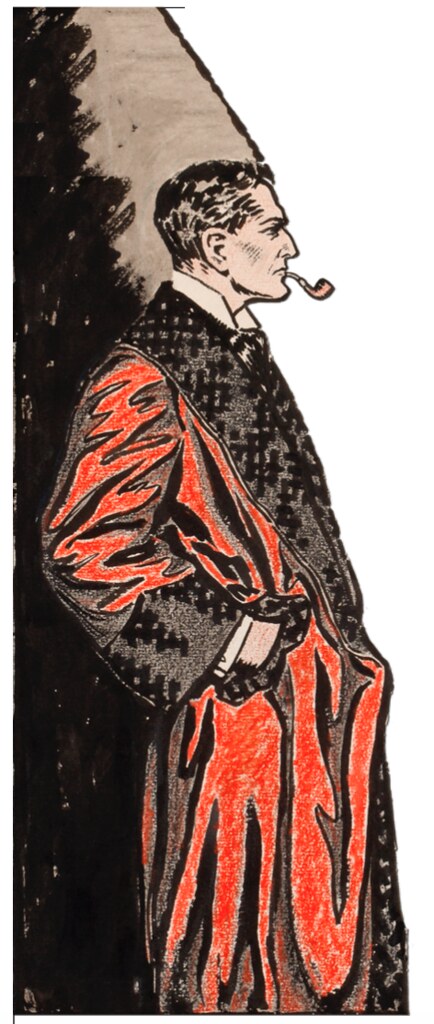
Sherlock Holmes in 221 Objects
Since his first appearance in 1887 during the 50th year of Queen Victoria’s reign, Sherlock Holmes has been nothing short of a literary juggernaut. The Great Detective who dazzled 19th-century readers is just as alive for their 21st-century counterparts, as evident in the Grolier Club’s first exhibition of 2022.
Sherlock Holmes in 221 Objects draws upon the preeminent Sherlock Holmes collection assembled by Glen S. Miranker, rich in bibliographic rarities, manuscripts, books, correspondence, and artwork, all with intriguing stories to tell beyond their significance as literary and cultural landmarks. Named for the address of the detective’s Baker Street lodgings, the exhibition presents items to captivate bibliophiles, Sherlockians, and general audiences.
Highlights include leaves from The Hound of the Baskervilles; four short story manuscripts; original artwork by the British and American illustrators who created Sherlock’s iconic look for readers; a wealth of holograph letters from Arthur Conan Doyle to friends, colleagues, and well-wishers; and a fascinating cache of pirated editions (books published without the author’s permission).
One-of-a-kind objects include the only known salesman’s dummy for the US Hound; a unique first UK edition of The Adventures of Sherlock Holmes in dust jacket; an “idea book” of Conan Doyle’s private musings in transition to the germ of stories; and a handwritten speech—never before displayed—with the author’s explanation for killing Holmes: "I have been much blamed for doing that gentleman to death but I hold that it was not murder but justifiable homicide in self defence [sic] since if I had not killed him he would certainly have killed me."
The exhibition opens not with Sherlock’s first appearance but with a story everyone knows, The Hound of the Baskervilles, presented through rarely seen and unique artifacts. It then reverts to the detective’s beginnings, focusing on Conan Doyle’s Sherlockian writings from A Study in Scarlet (1887) through the publication of The Return of Sherlock Holmes (1903).
Visitors to the exhibition will readily see evidence of Glen’s favorite collecting strategy: assembling “clumps.” “I like to assemble objects that tell a richer story as a group than they can individually,” he explains. “They offer more insight together, imparting a more complete understanding than one object can do singly.” Some examples:
- By itself, the Newnes Sixpenny edition of the Hound is a striking book, but its impact is more complete when one reads Conan Doyle’s note agreeing to its publication and also sees the original artwork for its cover. It’s a clump that provides a richer view of a moment in the life of the author and in the ongoing publication history of the Hound.
- During the three decades that William Gillette performed in the play Sherlock Holmes, his phenomenal publicity machine cranked out all manner of souvenirs, posters, and programs—all represented in Glen’s collection. But for the human side of the business of show business, Glen prizes Gillette’s correspondence with Conan Doyle, including a 1901 Christmas card with this note: “Did you ever imagine that Sherlock would be sending his compliments to his maker?”
Glen’s collection is also known for its singular objects and items with odd backstories, which he pursues relentlessly, for revelations that go beyond two-dimensional text on the page:
- As a bibliographic oddity, the copy of The Sign of the Four owned by Chicago businessman H. N. Higinbotham can’t be topped. It’s a piracy, a publishing practice that enraged many authors, Conan Doyle included. Yet Conan Doyle inscribed this book to Higinbotham, who also signed it and tucked in a ticket stub from the 1893 World’s Columbian Exposition, which he helped organize.
- For another backstory, consider the only known copy in dust jacket of the first UK edition of The Adventures of Sherlock Holmes (1892). It was uncertain whether it had been published in a dust jacket until a copy surfaced in 1981. Among its owners, in the 20 years before Glen acquired it, was a man who was not only the most notorious literary forger of the 20th century but also a murderer.
The Sherlockian Canon is small—just 56 short stories and four novels—but the opportunities and challenges for a gently mad collector are vast, often daunting, always irresistible. To Glen, the game is perennially afoot.

The Daniel Press: Pioneer of the English Private Press Movement


The Daniel Press
Pioneer of the English Private Press Movement
The Daniel Press occupies a unique place in the history of private printing. Active in Oxford from 1874 to 1906 (and as early as 1845 in Frome, Somerset), the Press founded by the Reverend C.H.O. Daniel (1836-1919) is, in some ways, a forerunner of the English private press movement and, in other ways, quite independent of it. The few dozen books produced by Daniel and his family for distribution among friends or to benefit charity are modest—even old-fashioned—in appearance, yet in their scale, distribution, and careful selection of literary content, layout, and typography, they far surpass other amateur printing ventures of the period. The Daniel Press thus represents an important bridge between Victorian domestic “parlor press” printing of the mid-nineteenth century and the mature Arts and Crafts private press movement of the 1890s.
 |
|
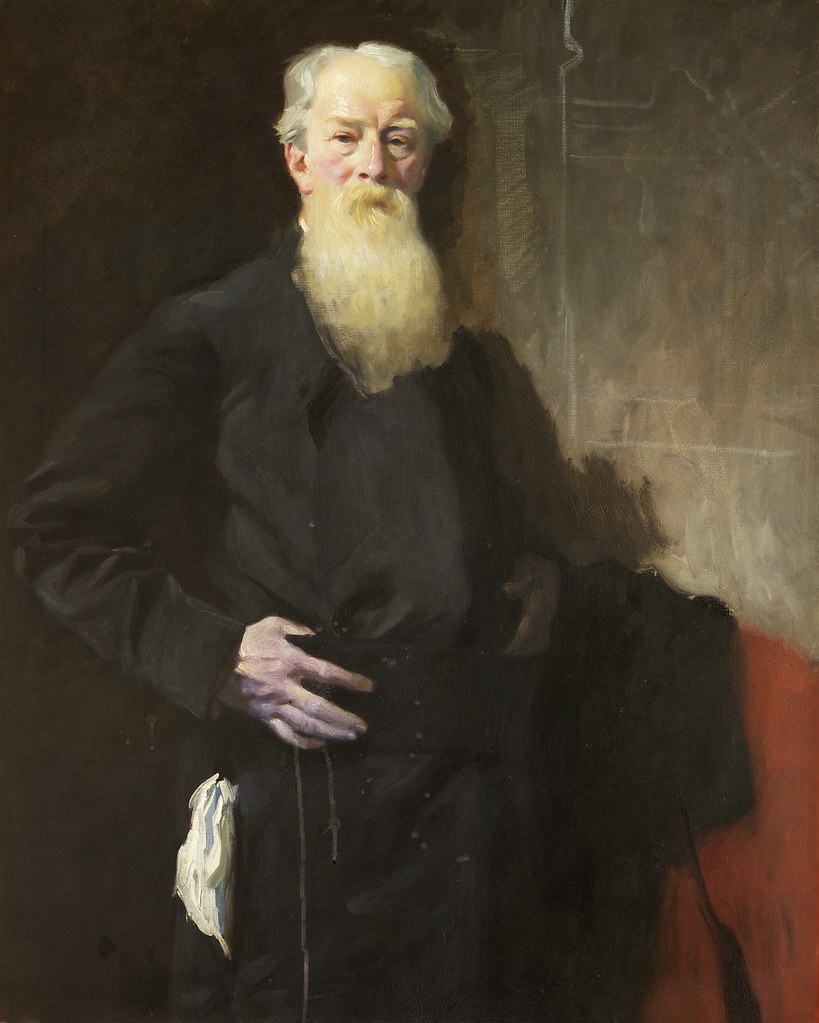
Charles Henry Olive Daniel by Charles Wellington Furse. Courtesy of the Provost and Fellows of Worcester College, Oxford |
This exhibition offers a survey of the Daniel Press from its earliest days in Frome to the modern works it has inspired. Particular attention is paid to the ‘golden years’ of the 1880s and early 1890s when Daniel’s revival of the Fell Types, his switch to a large Albion press, and the expansion of his literary networks gave the works a more sophisticated appeal. It is organized by theme, each shedding light on the press from a different angle. Items are drawn from the Grolier Club Library’s rich holdings, recently enhanced by the surprise discovery in the archives of twenty uncatalogued Daniel Press books donated in 1939. The exhibition is rounded out by a loan of nearly twenty books, prints, photographs, and pieces of ephemera, including the famous <em>Garland of Rachel</em>, from the remarkable Mark Samuels Lasner Collection, University of Delaware Library, Museums and Press, as well as spectacular individual items lent or donated by other club members (Philip R. Bishop, H. George Fletcher, Jon A. Lindseth, George Ong, John Windle). My special thanks go to the Grolier Club Modern Fine Printing Committee for sponsoring the exhibition.
Curator: Meghan R. Constantinou, Grolier Club Librarian
Treasures from the Hispanic Society Library / Tesoros de la Biblioteca de la Hispanic Society


In 1892, Archer M. Huntington, inspired by his great love for Spain, set out to establish a museum and library that would encompass practically every aspect of the cultural life of the peoples of the Spanish- and Portuguese-speaking worlds. Drawing on the unparalleled collections in the Hispanic Society, this exhibition of more than one hundred manuscripts and books presents an exceptional vision of the history and culture of Iberia and the Americas. The history of Spain is featured in medieval charters, holograph royal letters, letters patent of nobility, manuscript Bibles, books of hours, as well as historical, scientific, and literary manuscripts. In particular, illuminated manuscripts, bindings and printed works will evoke the “era of convivencia,” the period in the late Middle Ages when Muslim, Christian, and Jewish peoples lived as neighbors in the Iberian Peninsula. The close ties to the Americas are evidenced by the sailing charts that document the increasing colonization by Spain, as well as by bilingual manuscripts (pictographs with glosses in Spanish) that show how indigenous and European traditions coexisted and influenced each other.
The printed material on view dates from the earliest works produced in Spain and the Americas through the early 19th century. Including almost every literary masterpiece from the period, these works document the rich cultural traditions of these lands. Among the works on view are first editions of Tirant lo Blanch (1490), La Celestina (1499), Lazarillo de Tormes (1554), Don Quijote de la Mancha (1605), and works by the Mexican poet, Sor Juana Inés de la Cruz (late 17th century) and the 17th-century criollo polymath, Carlos de Sigüenza y Góngora. Also included is the only known copy of the first book printed in Puerto Rico, Juan Rodríguez Calderón’s poetry collection, Ocios de la juventud, published in 1806.
Curated by Mitchell A. Codding and John O’Neill
En 1892, Archer M. Huntington, inspirado por su gran amor por España, se propuso establecer un museo y una biblioteca que abarcaran prácticamente todos los aspectos de la vida cultural de los pueblos de habla hispana o portuguesa. Basándose en las ricas colecciones de la Hispanic Society, esta exposición de más de cien manuscritos y libros presenta una visión excepcional de la historia y cultura de Iberia y las Américas. La historia de España se presenta en cartas medievales, cartas reales holográficas, ejecutorias de nobleza, Biblias manuscritas, libros de horas, así como manuscritos históricos, científicos y literarios. En particular, los manuscritos iluminados, las encuadernaciones y las obras impresas evocarán la “era de convivencia,” el período de finales de la Edad Media en el que los pueblos musulmanes, cristianos y judíos vivían como vecinos en la Península Ibérica. Los estrechos vínculos con las Américas se evidencian en las cartas náuticas que documentan la creciente colonización por España, así como en manuscritos bilingües (pictografías con glosas en español) que muestran cómo convivieron y se influyeron mutuamente las tradiciones indígenas y europeas.
El material impreso expuesto data desde las primeras obras producidas en España y las Américas hasta principios del siglo XIX. Incluyendo casi todas las obras maestras literarias de la época, estas obras documentan las ricas tradiciones culturales de estas tierras. Entre las obras expuestas se encuentran las primeras ediciones de Tirant lo Blanch (1490), La Celestina (1499), Lazarillo de Tormes (1554), Don Quijote de la Mancha (1605) y obras de la poetisa mexicana Sor Juana Inés de la Cruz (finales del siglo XVII) y el erudito criollo del siglo XVII, Carlos de Sigüenza y Góngora. También se incluye la única copia conocida del primer libro impreso en Puerto Rico, la colección de poesía de Juan Rodríguez Calderón, Ocios de la juventud, publicada en 1806.
Comisariado por Mitchell A. Codding y John O’Neill
Treasures from the Hispanic Society Library and the accompanying catalogue and programs have been made possible, in part, by Pine Tree Foundation of New York and generous Patrons of the Hispanic Society.
Tesoros de la Biblioteca de la Hispanic Society, el catálogo y los programas que acompañan la exposición han sido posible, en parte, gracias al apoyo de Pine Tree Foundation en Nueva York y las generosas contribuciones de Patronos individuales de la Hispanic Society.
"The Great George": Cruikshank & London's Graphic Satirists (1800-1850)


I collect 19th- and 20th-century caricature, focusing on London and Paris in the first half of the 19th century. My previous exhibition exploring French caricature during the reign of Louis Philippe (1830–1848), centered on Charles Philipon, the publisher who launched the great French satirical journals of the July Monarchy and the careers of the greatest French comic artists of the time, Honoré Daumier, J.-J. Grandville, Cham, and young Gustave Doré. The protagonist of this exhibition is George Cruikshank (1792–1878), arguably the greatest British graphic humorist of the first three decades of the 19th century, whose working life spanned over 70 years and the reigns of the four monarchs who ruled Great Britain during the 19th century.
This exhibit covers only the first half of Cruikshank’s life (1792-1850), during which time English society underwent a sea change from an 18th century aristocracy, dominated by an aging and sick George III and a profligate Regent (George IV), that was engaged in a costly war with France, to the early Victorian era with its growing middle class, struggle for representative government and reform, increased literacy, industrialization, and the shift from an essentially agrarian to an urban society.
Cruikshank was schooled by the great humorists and engravers of the Regency. Once that generation faded, at age 19, he became the dominant figure in the artistry of English humor for over two decades. From roughly 1811 to 1836, whether by his colorful copper etchings of little Boney and the Prince Regent, or later through the books and pamphlets published primarily for his witty and endearing images, “the Great George” was a rock star, hailed by critics and sought after by publishers. By the late 1840s, however, with the great success of Mr. Dickens, the arrival of Punch, and the introduction of mass printing of images, Cruikshank was eclipsed by a new generation of artists. The author, not the illustrator, became the principal moving force in the book world. And by the early 1850s, having lost his first wife and married a second, he had become an ardent supporter of the temperance movement, longing to be a respected artist of middle class society. While he remained highly productive for the next 20 years, the whimsical quality of Cruikshank’s images diminished, and the 18th century skills of his fine etchings were of little import in the world of Victorian publishing.
Curated by Josephine Lea Iselin

100 Books Famous in Typography


In 1902 The Grolier Club mounted an exhibition called One Hundred Books Famous in English Literature. The exhibition and its accompanying catalogue were a major success. To this day people refer to books distinguished by inclusion in that show as milestones in the history of writing in the English language. The show spawned a series of Grolier Hundred books, including one hundred books famous in early American literature, science, medicine, twentieth-century fine printing and children’s literature. Each of these six compilations has become a key reference in its respective field.
One hundred books famous in typography seems like a natural topic for a Grolier Hundred. The Grolier’s mission is to “foster the study, collecting, and appreciation of books … their art, history, production, and commerce.” What could be more essential to the production of books than printing type? Therefore, what subject would be more suitable for the next Grolier Hundred than typography? Following the format of the six previous Grolier Hundred exhibitions, this selection presents milestones in the development and study of this important field.
Typography is an art essential to the book (though not all books). It has a long and distinguished history, beginning with Gutenberg’s ingenious development of a system for reproducing texts, through new technologies such as hot-metal line casting, phototype and the digitally generated type of today. Along the way numerous practitioners, such as Garamond, Baskerville, Bodoni and Zapf, have raised the work of type design and typography to the level of a fine art. In addition, there is a rich trove of volumes relating to the study of typography, including classics such as Moxon’s Mechanick Exercises, Enschedé’s Typefoundries in the Netherlands, Updike’s Printing Types, Morison’s Four Centuries of Fine Printing, and numerous other volumes.
Through almost six centuries many individuals have raised the practice of typography to the level of a fine art. It has been studied intensively, if not exhaustively. An overview of this important art, encompassing its history and study, is what we endeavor to display with these one hundred prime examples.